
by Rowan Fynn
(Writers on Writing: Shadowfax Writing Tips)
We all know and love that incredible feeling of reading a great book. Especially those moments when we suddenly realize we’ve been sitting in a chair, at a bookstore, on a bus, reading for hours. We forgot where we were or weren’t even aware we had been transported somewhere else, to another realm. Perhaps a distant galaxy.
There’s nothing quite like spending quality time with characters who exist only on a page—until they come to life in our minds. As we read those little symbols printed on each page, strung together in sentences, stacked in paragraphs, we somehow get to meet imaginary people, care about them, root for or against them.
It’s magical, right?
That’s exactly what the best writers aspire to create: an unbroken spell created with a scroll of words, a narrative illusion that takes us into imaginary realms and gives us the ride of our lives—makes us laugh, cry, think, feel, walk or run in someone else’s shoes, grip the edge of our seats … and keeps us coming back for more.
Fiction is a dreamlike narrative spell that must never be broken. Nothing should accidentally awaken the reader from that dream.
Aside from creating interesting, three-dimensional characters, a strong plot, and an intriguing premise, our word choices, engaging sentences, and paragraph structure all help to create mood and tone in a story, weaving a narrative incantation to keep the reader spellbound.
A Spell That Should Not Be Broken
All writers develop tics and habits as they write (or learn to write). Even the best writers.
Sometimes, that’s just an aspect of developing Voice, the distinctive way each author tells a tale. Other times, tics and habits can become a disruption in the flow of a story, like someone who uses the same word over and over and over, anyway they can.
Too many overs, right? Not good. That breaks the narrative spell.
Do you have unintentional patterns in your sentences and paragraphs? For example, do you always start sentences with pronouns? She did this. He did that.
Is noun-verb-object your common go-to when writing sentences? Or do you shake it up?
Look at what I did in the paragraphs above—or below. Do you see a particular pattern in the sentences? Did you notice any repetitive words or familiar cadence as you read these sentences? Or are they unpredictable?
If nothing disrupts or distracts a reader as they read, that’s good. The magic is working. Any blips that interrupt the reading experience are spell-breakers that can kick a reader right out of an otherwise engaging story (and your story world).
Notice I said “unintentional patterns.” Sometimes, an intentional pattern can be used to build tension, or highlight something important, or drive the reader to a Big Moment (see the Tolkien example below). But any repetitive technique must be used carefully.
Nevertheless, if there is one basic thing that can improve readability in many of the stories aspiring writers create, it would be this: Shake it up and keep it fresh.
What Does That Mean?
Staggering the rhythm, cadence, and patterns of your sentences draws the reader into a story and helps them stay engaged.
For example, starting every sentence with He or She would not be fun to read page after page. Compare this:
He stepped forward and drew his sword. He lunged and his opponent dodged. He ducked and swung his blade.
with this:
He drew his sword and stepped forward. As he lunged, his opponent dodged. The man was quick, already swinging. When the blade whistled over his head, he tried again. Too late—
Readers want to be surprised by a sentence every now and then, as you guide them from one action, reflection, emotional response, or Ah-Ha moment to another. Sentence patterns, rhythm, and cadence (along with word choices) can do that. They’ll are part of a dream-wizard’s arsenal.
Is a particular moment in a scene introspective and thoughtful? Straight exposition or action? Is the language in a sentence hurried and staccato (action), or very patient and melancholy (introspection and reflection)?
The length and type of paragraphs (or sentences in a paragraph) can maintain or change the mood in a scene. In a second.
(See that quick flip? Alacazam)
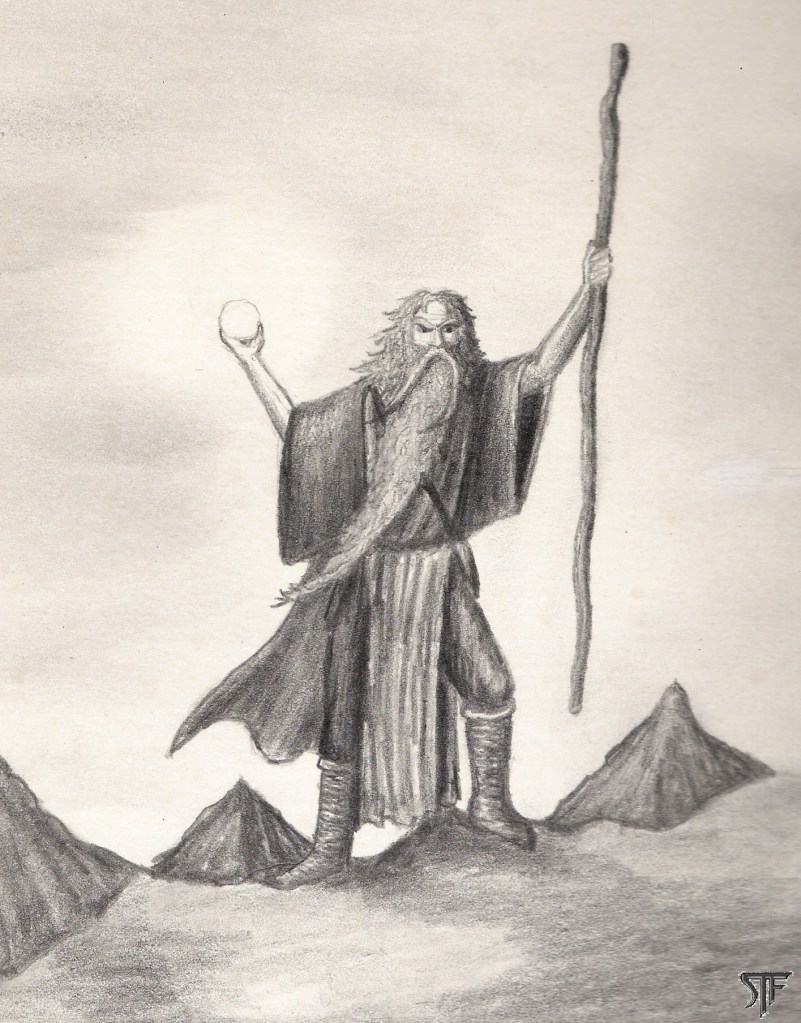
Too many sentences that use the same pattern or word choices, placed too close together, can quickly become distracting. Or feel formulaic. No one likes that.
Repetitive sentences don’t feel like a natural, conversational narrative voice, because that’s not the way people talk or tell stories. Capturing the way people talk (or the semblance of that in narration) is where the real magic lies.
How To Spell-Weave as You Write
If you want to change it up and keep things fresh, search your manuscript for sentences and paragraphs that use the same pattern. For example, look down the page for sentences and paragraphs that start with the main character’s name, or He or She. Then change sentence structure here and there to break the pattern.
Some people start too many sentences with gerunds (-ing words and phrases like “Glancing sideways…”). If that’s you, do something different every now and then. Other people never start sentences or paragraphs with gerunds, so try a scattering a few in your writing.
For those who automatically use too many long sentences, break it up with short ones. Shorter sentences mixed with longer sentences become ideas that forcefully break into other thoughts, or form atmospheric language, leading the reader deeper into a character’s state of mind or predicament.
But keep it natural. Read it aloud to see how it sounds to your ear (the best judge of good storytelling).
You don’t want to overdo it either way, but switching things up can make your narration feel more natural and fresh—and it can really boost the reader’s enjoyment of your story.
Take a Look atWriting You Admire
Grab any of your favorite books from the shelf and read a few random paragraphs on a few random pages. Only look at paragraph structure and the cadence of sentences.
It should be easy to see how the best authors generally start and end sentences (and paragraphs) in different ways throughout the page. Keeping it fresh and unpredictable. Or even surprising.
Here are a few good examples of staggering cadence and structure that you might recognize:
Game of Thrones by George R.R. Martin —-
The man had been taken outside a small holdfast in the hills. Robb thought he was a wilding, his sword sworn to Mance Raider, the King-beyond-the-Wall. It made Bran’s skin prickle to think of it. He remembered the hearth tales Old Nan told them. The wildlings were cruel men, she said, slavers and slayers and thieves. They consorted with giants and ghouls, stole girl children in the dead of night, and drank blood from polished horns. And their women lay with the Others in the Long Night to sire terrible half-human children.
Dune by Frank Herbert —
Paul fell asleep to dream of an Arrakeen cavern, silent people all around him moving in the dim light of glowglobes. It was solemn there and like a cathedral as he listened to a faint sound – the drip-drip-drip of water. Even while he remained in the dream, Paul knew he would remember it upon awakening. He always remembered the dreams that were predictions.
The Adventures Of Huckleberry Finn by Mark Twain——
You don’t know about me without you have read a book by the name of The Adventures of Tom Sawyer; but that ain’t no matter. That book was made by Mr. Mark Twain, and he told the truth, mainly. There was things which he stretched, but mainly he told the truth. That is nothing. I never seen anybody but lied one time or another, without it was Aunt Polly, or the widow, or maybe Mary.
AND FINALLY, THIS GREAT EXAMPLE FROM TOLKIEN—-
Grond crawled on. The drums rolled wildly. Over the hills of slain, a hideous shape appeared: a horseman, tall, hooded, cloaked in black. Slowly, trampling the fallen, he rode forth, heeding no longer any dart. He halted and held up a long pale sword. And as he did so, a great fear fell on all, defender and foe alike; and the hands of men drooped to their sides, and no bow sang. For a moment, all was still.
The drums rolled and rattled. With a vast rush, Grond was hurled forward by huge hands. It reached the Gate. It swung. A deep boom rumbled through the City like thunder running in the clouds. But the doors of iron and posts of steel withstood the stroke.
Then the Black Captain rose in his stirrups and cried aloud in a dreadful voice, speaking in some forgotten tongue words of power and terror to rend both heart and stone.
Thrice he cried. Thrice the great ram boomed. And suddenly upon the last stroke the Gate of Gondor broke. As if stricken by some blasting spell it burst asunder: there was a flash of searing lightning, and the doors tumbled in riven fragments to the ground.
In rode the Lord of the Nazgul. A great black shape against the fires beyond he loomed up, grown to a vast menace of despair. In rode the Lord of the Nazgul, under the archway that no enemy ever yet had passed, and all fled before his face. All save one.
There waiting, silent and still in the space before the Gate, sat Gandalf upon Shadowfax: Shadowfax who alone among the free horses of the earth endured the terror, unmoving, steadfast as a graven image in Rath Dinen.
‘You cannot enter here,’ said Gandalf, and the huge shadow halted.
———————————
Wowzers, right? Talk about a wizard.
But look at the first word of each paragraph Tolkien wrote. Nothing repetitive. Each starts with a fresh word compared to the paragraphs above and below it. The sentences move back and forth between short and long, complex and simple.
The few times he repeats a word or starts two sentences with “It” (for example) are intentional, building toward the sentences that follow. Pure narrative magic.
You Can Be a Wizard Too
Just remember … every story starts with a single word, followed by more word choices, sentences, paragraphs, building chapter by chapter, until you reach The End.
One way or another, if you have an amazing story to tell and you tell it the best way you can, readers will be interested—and moved. That, after all, is a storyteller’s goal. It’s the magic of both writing and reading.
Stay true to yourself. Find your voice. Bring your characters to life and weave your magic.
Make it happen. Tell your story. Then revise and edit until it’s the best you have to offer.
After that, share it. Show the world what you can do.
You are a wizard after all. So, go make some magic.
THE AUTHOR:
A lifelong dreamer and adventurer, Rowan Fynn now strives for a simple life, writing in a small cabin in the mountains. He is the author of GAME-WORLD: PRISONERS OF ANDARA and SCOURGE OF THE UNDEAD.
 Shadowfax Books