An Exploration of Superhero Diversity and Representation
by S. T. Finn
If you’ve always wanted to learn more about superhero beginnings and representation in comics, this is the place.
This 10-Part article provides a glimpse into pioneering trailblazers, important first appearances, and the evolution of under-representation in comics.
Part 1 lays the groundwork and sets up our Superhero Criteria.
Part 2 examines the beginning of superheroes (and their predecessors).
Part 3 delves into changing readership imbalances and the romance genre.
Part 4 honors first appearances of important female superheroes.
Part 5 appreciates trailblazing female BIPOC superheroes
Part 6 presents important first appearances of Black superheroes.
Part 7 explores Asian, Hispanic/Latino, and Native American superheroes.
Part 8 celebrates first appearances of superheroes with disabilities.
Part 9 looks at the first gay, lesbian, trans, and nonbinary superheroes.
Part 10 brings it all to a dramatic conclusion.
NOTE: As we discussed in Part 1, for the purposes of this article, a superhero is defined as a crime-fighter who fights for justice, and MAY have a mask, cape, or costume, and/or a secret identity, but MUST possess at least one of the following: 1) a special, peak-human, or unnatural skill or talent; 2) unique tech/gadgets used for crime-fighting; 3) a supernatural ability of some kind; OR 4) an actual super-power.
ALSO, if a hero does not possess a superpower, our Superhero Criteria stipulates that supernatural abilities MUST exist somewhere in the fictional universe for the hero to be considered a superhero (otherwise, they are “simply” a hero, vigilante, or crime-fighter).
With some exceptions, this article focuses mainly on mainstream American comics.
Part 2: Beginnings
Before getting to the first underrepresented superheroes, we need to take a look at some important precursors who debuted BEFORE the First Superhero even showed up in comics.
While Superman (Clark Kent) is universally recognized as the FIRST popular, costume-and-cape comic book superhero, many earlier characters paved the way.
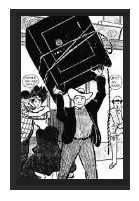
Appearing in a Chicago Tribune comic strip way back in 1902, Hugo Hercules might be the actual First Superhero in comics.
Although comic books and superheroes as we know them didn’t exist just yet, comic strips in newspapers were certainly a forerunner.
Good-natured and friendly, Hugo used his powers to help people with their everyday problems.
While Hugo didn’t wear a mask or a costume (other than his hat, he possessed superhuman-strength (he was able to lift cars over his head and punt houses like footballs). That means he fits the Superhero Criteria.
The next character does not (although he still deserves a mention).
The Shadow (Lamont Cranston) debuted on radio and in pulp magazines in 1930. He later appeared in comic-book form in 1940 (with the release of Shadow Comics #1).
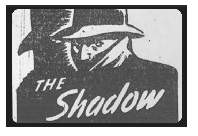
An extremely popular masked vigilante, The Shadow utilized special abilities like “clouding men’s minds” to become invisible.
He was a master of disguise, hypnotism, and marksmanship—and he used a device on his fingertips called “The Devil’s Whisper” (a chemical compound that allowed him to create a flash of fire and an explosion when he snapped his fingers).
To his opponents, all these attributes created the illusion that The Shadow was a supernatural entity. (He wasn’t.)
A few of his abilities even fit into our criteria. But is it enough?
Not quite. Because NO superpowers existed in the fictional world of The Shadow.
Therefore, according to our Superhero Criteria, The Shadow was a pulp hero, not a superhero. However, his influence on Golden Age superheroes that followed cannot be underestimated.
Almost a hundred years later, “Only The Shadow Knows” is a phrase most of us still remember today—for a reason.
Created to rival The Shadow, another 1930s pulp figure was The Spider (Richard Wentworth), who made his first appearance in The Spider Strikes! (October 1933—before The Shadow appeared in comics).
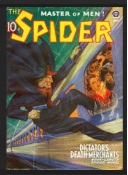
A rather brutal caped vigilante, The Spider used disguises and heavy firepower to fight crime in the streets. However, he does not fit our Superhero Criteria, even though he was highly influential (if not remembered as much as The Shadow).
Again, there were no superpowers in his world.
Another hero who remains fairly well-known today is The Phantom (Kit Walker).
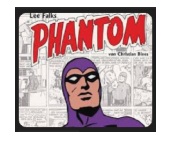
Debuting in newspaper strips in 1936, the Phantom deserves credit as the first costumed and mask-wearing comic strip hero—fighting for justice two years before Superman appeared.
And yet, The Phantom also existed in a world with no superpowers.
Created by Centaur Publications, the non-superhero Arrow (Ralph Payne) first appeared in September 1938 as a secret intelligence agent who utilized his skills as an archer to fight crime (he also existed in a fictional universe with no powers).
The Arrow is relevant in this article because he used trick arrows to fight criminals, predating the much more famous Green Arrow (who debuted in November 1941).
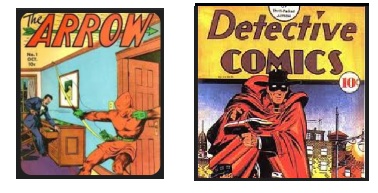
Batman (Bruce Wayne) arrived on the scene packing a gun in Detective Comics #27 (March 1939). But seven comic book issues earlier, the Crimson Avenger (Lee Travis) made his debut in Detective Comics #20 (October 1938.
While the Crimson Avenger eventually gained powers in the comic books, initially he was a masked, gun-toting detective, very similar to the Shadow.
He was a highly skilled athlete, marksman, and hand-to-hand combatant who relied on his wits and training in Judo/Karate.
The Crimson Avenger utilized a signature gas-gun that emitted a scarlet smoke-cloud to disorient opponents, render them unconscious, or create dramatic, stealthy entries. He also drove a special armored car.
On top of that, the Crimson Avenger existed in a world of superpowers (DC Comics), so he fits our criteria as a superhero. (See more about Crimson Avenger’s sidekick Wing in Part 7.)
The Green Hornet (Britt Reid) was a masked vigilante who fought crime using trick-gadgets, his wits, and his resourceful partner Kato (see Part 7 for more on Kato).
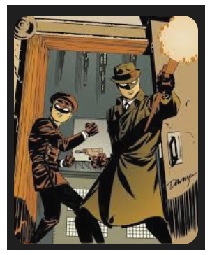
Although the Green Hornet debuted on radio in January 1936, his first appearance in comics wasn’t until December 1940—the same year that saw the debut of The Flash, Green Lantern, Captain Marvel (Shazam), Robin (Dick Grayson), Fantomah, The Spectre, Doctor Fate, Hawkman, Catwoman, Blue Beetle (Dan Garrett), Plastic Man, the Justice Society of America (the world’s first superhero team), and many other supers.
It was a monumental year for comics—and just getting started.
Some of the First Superheroes in the World
As we finally turn our focus toward underrepresented characters in comics, we should mention two top candidates for First Superhero Ever who are rarely mentioned … because they weren’t American.
One is Japanese and the other is a French woman.
Ōgon Bat (Golden Bat) was a popular caped character in Japan who first appeared in kamishibai (paper theater) in 1930.
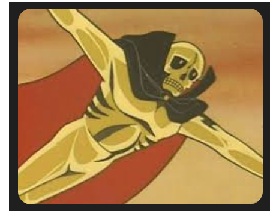
A champion of justice, he was depicted with a skull-like face and super-strength. He wielded a special baton—and he could fly. If the Golden Bat had appeared in mainstream American comics, he definitely would have fit our Superhero Criteria.
Nevertheless, he is one of the world’s first superheroes.
Then … there’s L’Oiselle (French for “The Bird”—or, more specifically, “Lady Bird” or “Bird-Girl”).
Created by a woman (novelist Renée Gouraud d’Ablancourt), L’Oiselle (Vega de Ortega) might be the world’s First Female Superhero—with a debut in 1909 (thirty years before Superman arrived). And she is the first superhero created by a woman. (For another, see Miss Fury in Part 4.)
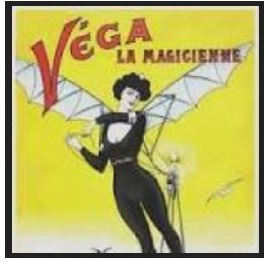
However, Lady-Bird’s exciting adventures were first published as a popular serialized novel rather than in comic books. And since she never appeared in mainstream American comics (or was even published in translation), for our purposes, L’Oiselle also does not fit the criteria for a comic book superhero.
However, she boldly chased thieves. She utilized special crime-fighting tech-gadgets (including night-vision and mechanical wings). She battled a secret organized-crime syndicate (who used advanced tech-gadgets).
And she even rescued a man (in 1909)—all while wearing a form-fitting, catsuit costume (the first) that allowed her to fly … about 50 years before Marvel’s Wasp.
So, Lady-Bird definitely deserves to be recognized (at the very least) for being one of the first superheroes in the world, for being the first superhero created by a woman—and for contributing to future conceptions of comic book supers.
American Heroes
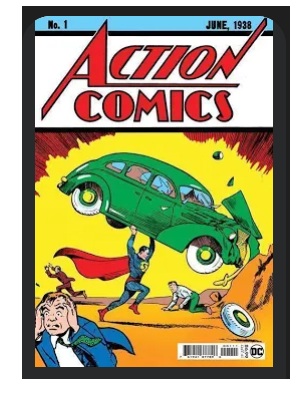
As mentioned above, the Golden Age of Comics (1938–1956) began with the revolutionary first appearance of Superman in Action Comics #1, released on April 18, 1938 (even though the cover-date was printed as June 1938). Batman appeared almost one year later. And Wonder Woman two and a half years after that.
Historically speaking, Superman is widely considered the first comic book hero to combine superpowers, a secret identity, and a distinctive costume (with a cape and a symbol)—which established the modern superhero archetype we’re all familiar with today. He’s also the first and most famous alien from another planet to become a hero on Earth.
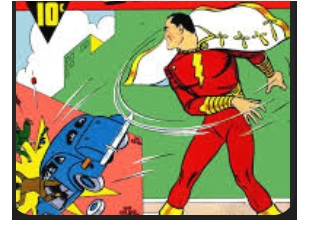
Incidentally, the Fawcett Comics superhero Captain Marvel (Shazam), debuted about two years after Superman, but he was once the most popular superhero of the 1940s, outselling even Superman.
Some reports claim that a single issue of Captain Marvel Adventures sold nearly a million-and-a-half copies (about a million more than the most popular comics today … eighty years later).
Interested in learning more about best-selling comics, important romance comic books, changes in gender readership, and other industry info?
Read on…
For more milestones in comic books, check out Part 3, where we explore more about the history of superheroes and the balance (or imbalance) of gender readership.

A lifelong collector of comic books, S. T. Finn is an author and artist who lives in a cabin in the Catskill Mountains. His stories and artwork can be found at ShadowfaxBooks.com.
 Shadowfax Books