An Exploration of Superhero Diversity and Representation
by S. T. Finn
If you’ve always wanted to learn more about the representation of superhero women in comics, we got what you’re looking for.
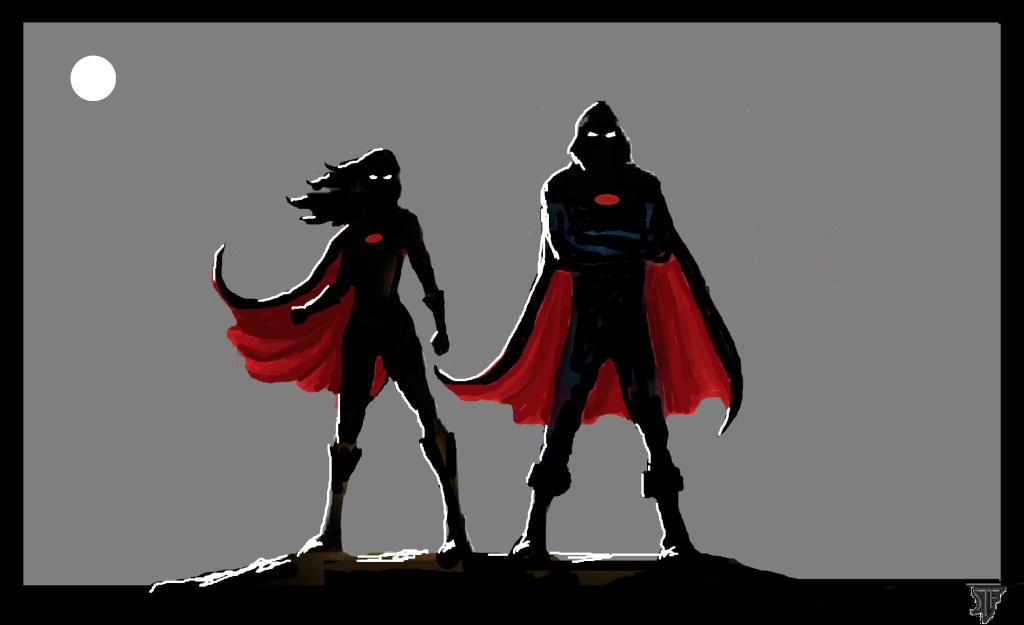
This 10-Part article provides a glimpse into pioneering trailblazers, important first appearances, and the evolution of under-representation in comics.
Part 1 lays the groundwork and sets up our Superhero Criteria.
Part 2 examines the beginning of superheroes (and their predecessors).
Part 3 delves into changing readership imbalances and the romance genre.
Part 4 honors first appearances of important female superheroes.
Part 5 appreciates trailblazing female BIPOC superheroes
Part 6 presents important first appearances of Black superheroes.
Part 7 explores Asian, Hispanic/Latino, and Native American superheroes.
Part 8 celebrates first appearances of superheroes with disabilities.
Part 9 looks at the first gay, lesbian, trans, and nonbinary superheroes.
Part 10 brings it all to a dramatic conclusion.
NOTE: As we discussed in Part 1, for the purposes of this article, a superhero is defined as a crime-fighter who fights for justice, and MAY have a mask, cape, or costume, and/or a secret identity, but MUST possess at least one of the following: 1) a special, peak-human, or unnatural skill or talent; 2) unique tech/gadgets used for crime-fighting; 3) a supernatural ability of some kind; OR 4) an actual super-power.
ALSO, if a hero does not possess a superpower, our Superhero Criteria stipulates that supernatural abilities MUST exist somewhere in the fictional universe for the hero to be considered a superhero (otherwise, they are “simply” a hero, vigilante, or crime-fighter).
With some exceptions, this article focuses mainly on mainstream American comics.
Part 4: Super Women
For much of comic book history (like many things in “his-story”), strong female characters have far too often been under-represented as superheroes.
But there were important, pioneering, unsung heroes who deserve recognition and appreciation (like L’Oiselle, previously mentioned in Part 2).
Below is a glimpse at some of those who paved the way for other beloved characters to follow.
Girl-Power Begins
It would be difficult to begin any discussion about female superheroes without starting with Wonder Woman (Diana Prince).
As soon as she appeared in All Star Comics #8 (October 1941—with a cover date of December), Wonder Woman became an immediate, best-selling sensation.
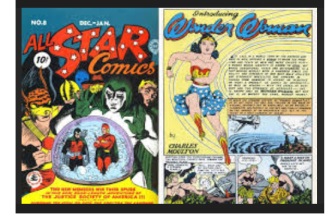
One of’ the most powerful superheroes in the entire DCU, Wonder Woman possesses superhuman strength, speed, and durability inherited from her Amazonian heritage and divine blessings from the Greek gods. That’s definitely super.
Often portrayed as a demigoddess (the daughter of Zeus and Hippolyta), Wonder Woman is considered a fearless defender of peace, ranking close to Superman in power.
Incidentally, when William Moulton Marston was creating Wonder Woman(pre-1941), he received major input and inspiration from his wife, Elizabeth, and from Olive Byrne (who was their live-in partner in a lifelong polyamorous relationship). Olive also wore the bronze bracelets that inspired those worn by Wonder Woman.
Historically, Wonder Woman was one of the first and most successful female superheroes, often appearing in multiple publications simultaneously. In July 1943, it was reported that sales for Wonder Woman #3 had reached 500,000 copies.
(To put that into context: The highest-printed single-issue comic books on sale today rarely exceed 500,000 copies for major, heavily promoted #1 issues. For more info on highest-selling comics, see the End-Note below.)
Wonder Woman was consistently a top-five bestseller in the 1940s, often competing directly with Superman and Batman. But she wasn’t the only female superhero in town.
Nor was she the first.
Original Trailblazers
Many people claim that Fantomah (the “Mystery Woman of the Jungle”) should be considered the First female comic-book superhero.
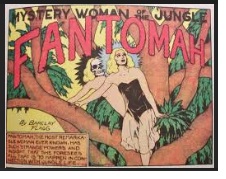
Fighting against ivory hunters and mad scientists, protecting the jungle with supernatural powers like flight and transmutation, Fantomah debuted in February 1940 (more than a year before Wonder Woman).
Her face also transformed into a blue skull when she summoned her powers. So … there’s that.
(Some people also claim a TV series is in the works for this forgotten hero, but I could find no confirmation.)
However, the Magician From Mars (Jane Q-X3), from Amazing-Man Comics (November 1939), predates Fantomah by almost three months.
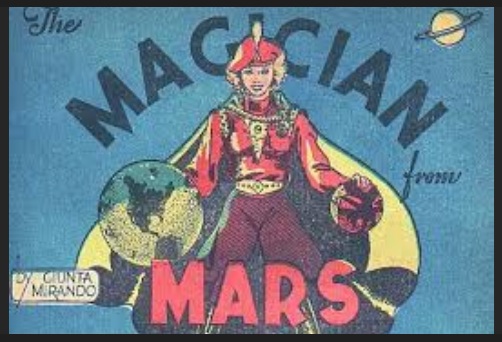
The Magician From Mars was a half-human, half-Martian hero who possessed psionic, telekinetic, and reality-warping powers. She also had super-strength, super-agility, and the power to create objects out of nothing—using willpower alone.
Initially, the Magician From Mars wore a distinctive (sometimes scantily clad) costume. But she fought crime and defended both Earth and Mars, so she certainly fits our criteria for a superhero.
Although never a widely popular character like Wonder Woman (or Sheena), the Magician From Mars still deserves credit for being the First Female Superhero in comics.
Woman in Red
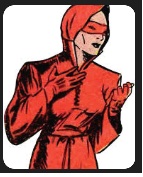
Mention should also be given to The Woman in Red (Peggy Allen), a police officer by day who fought crime by night in a red mask, gloves, and hooded cloak. She first appeared in Thrilling Comics #2 (March 1940).
A vigilante without superpowers, she was an expert with firearms, skilled in judo/jujitsu, and she possessed high deductive intelligence.
While The Woman in Red was not a superhero according to our criteria, she deserves recognition as the first masked, costumed female crime-fighter in comics.
The Power of The Cat
Introduced simply as “The Cat” in Batman #1 (April 1940), Catwoman (Selina Kyle) is considered more of a “morally grey” anti-heroine (or a reformed villain) rather than a traditional superhero.
While Catwoman often drifts between being an ally or an adversary of Batman, she is a skilled jewel-thief and cat-burglar driven primarily by self-interest and usually operating outside the law. But she’s also known for following a strict personal / moral code.
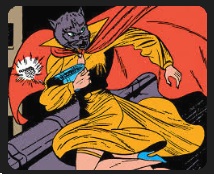
Initially, she didn’t wear her now-iconic skintight black “catsuit” (coined after the Catwoman character famously portrayed by Julie Newmar and then Eartha Kitt in the 1966 Batman TV show).
(Side-Note: the first use of the famous leather catsuit was worn by Emma Peel, debuting in the British Avengers TV show (1965), see Miss Fury below for the first appearance of a catsuit in comics (1941). For perhaps the first appearance of a superhero catsuit anywhere, see L’Oiselle in Part 2.
When Catwoman first debuted, she wore a simple green ball-gown and often wore a cat-mask or various disguises (sometimes as an old woman). She wore a prototype form-fitting suit was in Batman #35 (1946), although it was more like a purple dress.
Inspired by depictions in the popular Batman TV show, Catwoman’s iconic catsuit didn’t appear in comic books until 1967 (though it was green and scaled at first).
Afterward, Catwoman continued changing her costumes (see left) for decades before the movies finally cemented the Miss Fury / Emma Peel-inspired catsuit as Catwoman’s distinctive look.
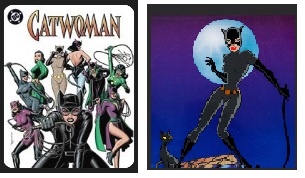
A strong and popular presence in more than eighty years in comics, Catwoman has long been recognized as a powerful symbol of female independence and agency—an intelligent, skilled, and self-reliant woman who thrives in a dangerous world, while living by her own rules.
Although she has no superpowers (aside from having nine lives), Catwoman is a peak-human acrobat, thief, and martial artist—often comparable to Batman in her agility and prowess in combat. And she lives in a world populated by super-powered individuals.
On this list, Catwoman deserves major credit for being able to stand her ground as an equal powerhouse in the midst of either superheroes or supervillains.
Female Vigilantes
Lady Luck (Brenda Banks) was a Golden Age comic book superheroine and crime-fighter who made her debut in newspaper comic strips on June 2, 1940.
Debuting in December 1940, the popular super-soldier Captain America (Steve Rogers) is often considered the first and most prominent comic book superhero of Irish descent (he was born to Irish immigrant parents in New York City). But Lady Luck is the first Irish-American female superhero.
Appearing in newspapers months before Captain America appeared in comic books, Lady Luck didn’t appear in comic books until April 1943 (in Smash Comics #42). By 1949, she gained her own title, Lady Luck.
As a socialite bored with high society (a common theme in Golden Age comics), Lady Luck adopted the persona of a “modern lady Robin Hood.” Typically wearing a distinct kelly-green dress, a large hat, and a green veil instead of a mask, she became a vigilante to fight crime.
While Lady Luck possessed no supernatural powers, she was a skilled detective and expert in jujitsu. She is also one of the earliest female crime-fighters in comics history.
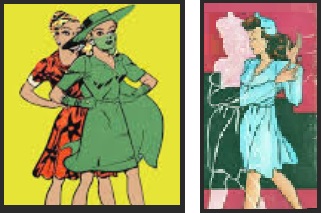
Debuting in newspapers on June 3, 1940 (one day after Lady Luck), Invisible Scarlet O’Neil (also Irish-American) was a pioneering, non-costumed female character in the early days of comic book heroes.
She was also one of the First Female Superheroes with superpowers.
Her father was a scientist, developing “a ray” for the US government. When Scarlet stuck her finger into the experimental ray, she (and her clothing) instantly became invisible.
Afterward, Scarlet could become invisible at will (by pinching a specific nerve in her wrist).
More of a plainclothes adventurer than a traditional costumed superhero, Invisible Scarlet O’Neil used her powers to fight criminals, Nazi spies, and saboteurs—although her early stories often focused on helping children.
Another important pre-Wonder Woman superheroine was Black Widow (Claire Voyant)—no relation to the much more famous Marvel super-spy Natasha Romanoff.
The Golden Age Black Widow first appeared in Mystic Comics #4 (August 1940), which was published by Timely Comics (the predecessor of Marvel).
Unlike her non-powered modern counterpart (Natasha Romanoff), the Golden Age Black Widow was an undead agent of Satan with supernatural powers (including superhuman strength, flight, and a lethal “death touch” to kill evildoers. No messing around there.
But she is often cited as one of the first costumed, super-powered female heroes in comics.
The Power of Fury
Another notable female superhero first appeared in April 1941 (six months before Wonder Woman): Miss Fury aka Marla Drake.
Much like L’Oiselle in 1909, Miss Fury was one of the few early female superheroes created, written, and drawn by a woman (June Tarpé Mills).
Originally called Black Fury, Marla Drake possessed a keen intellect, expert skills in hand-to-hand combat, and she was proficient in firearms. On top of all that, the resourceful Miss Fury frequently used everyday objects, such as ice buckets, pots and pans, or telephones to clobber her opponents.
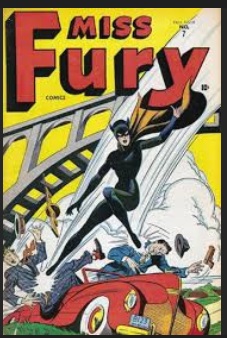
She was known to outsmart more than outfight villains, always thinking on her feet, though she could easily fight when she had to. She was an independent woman and a hopeless romantic, with a series of single men who pined after her.
Perhaps because she was created by a woman, Marla Drake was a working fashion designer (while many other female heroes, created by men, were presented as secretaries or bored socialites).
Mills used herself as the primarily model for Drake—in more ways than one (see the photo of Mills with her cat below).
While fearlessly battling Nazis, Miss Fury also wore her iconic skintight “black panther” (or leopard) fur suit with a cat-eared mask. She inherited from her uncle, who claimed it had been used “by an African witch-doctor” in mystical ceremonies.
As mentioned above, Miss Fury was the first superhero to wear a skintight black catsuit (two decades or more before Emma Peel, Catwoman, and Black Panther wore their almost-identical costumes in the late 1960s).
While Miss Fury herself lacked inherent superhuman abilities, her supernatural panther-suit imbued her with good luck, as well as increased strength and speed. The suit also was equipped with razor-sharp claws on the hands and feet (and she often used the tail as a whip to disarm her opponents).
Unlike some of the earlier characters we mentioned above, Miss Fury was extremely popular, particularly during World War II.
She was so popular with US troops that her name and/or image was painted on the nose of at least three American B17 and B24 bombers.
Miss Fury’s cat Perri-Purr also became an unofficial mascot of many American troops.
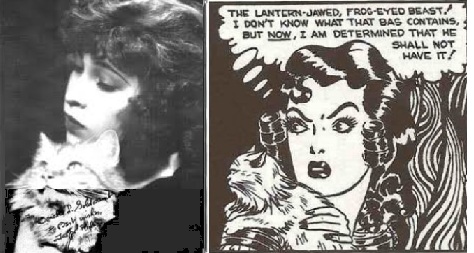
(Writer/artist/creator June Tarpe Mills with her cat Perri-Purr (left); Marla Drake with her cat (right).
At its peak of success, the Miss Fury comic strip was featured in more than 100 newspapers.
When Timely Comics (the predecessor of Marvel) collected and reprinted the Sunday strips from 1942 to 1946, they sold over a million copies per issue. In the entire history of comics, those are top-tier numbers.
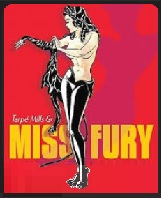
In part, Miss Fury’s popularity may have been driven by her rather “risque” image. Marla and her nemesis (Baroness Erica Von Kampf) were frequently shown changing clothes, taking baths, or walking around in lingerie.
But in 1947, when the character was depicted in a bikini, 37 newspapers removed her comic strip from their line-up in protest.
However, Miss Fury often featured rather complex and progressive storylines for the times, even showing Marla Drake navigating her life as a single mother (after she adopted her arch-enemy’s toddler)—a role that had never been represented in comics before.
While the popularity of Miss Fury eventually declined after the war, and the comic strip officially ended with Mills’ retirement by 1952, Miss Fury is still recognized as a significant figure in Golden Age comics and a trailblazing female superhero.
Like many of the heroes in this article, she is now in the public domain.
(Instead of rolling out more remakes and endlessly familiar heroes, where is Miss Fury’s movie or TV show?)
Another Popular Invisible Superhero
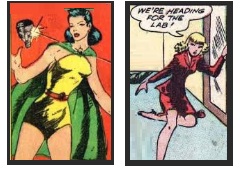
Phantom Lady (Sandra Knight) debuted in Police Comics #1 (August 1941). After an attempt on her father’s life (he was a US senator), she became a vigilante to fight crime—and Nazis.
While not possessing actual superpowers, Phantom Lady utilized advanced technology, such as a “black-light” projector (a “black lantern”) to create darkness and become invisible to her opponents.
Fighting Nazi agents and criminals (who often did possess supernatural qualities—including a robotic villain), Phantom Lady is considered one of the earliest prominent female superheroes, debuting alongside characters like Plastic Man.
(She was later acquired by DC Comics).
Jill Trent
One last Golden Age female hero to mention here is Jill Trent (the Science Sleuth).
Debuting in 1943, Trent was a pioneering scholarly female superhero who solved mysteries and battled crime with STEM approaches and cool tech-gadgets.
She blinded them with science.
Although Trent possessed no superpowers (or skin-tight suits), she apprehended criminals through the use of her keen intelligence, adaptive skills, and scientific prowess.
She also was capable of using a gun, if necessary.
While solving crime, Jill Trent also invented many technological wonders—including an “Infra-Red lamp” and glasses that could see through objects.
Not a superhero, according to our criteria, she still deserves credit for being a pioneering comic book trailblazer.
(Recently, Jill Trent even got her own TV series, after being nearly forgotten for decades.)
There are many other important female superheroes who once graced the pages of comic books long ago—including the heroes featured in the next section.
For more milestones in comic books, check out Part 4, where we explore the first appearances of Black, Hispanic/Latina, Indigenous, and Asian superheroes.
END-NOTE: The highest-printed single-issue comic books on sale today rarely exceed 500,000 copies for major, heavily promoted #1 issues. Only about a dozen comic book issues have EVER sold more than 2 million copies. What was the best-selling single-issue comic of all time?
X-Men #1 (1991) sold over 8.1 million copies (with at least five variant covers). X-Force #1 (also in 1991) was reported to have sold approximately 5 million copies. However, these kinds of sales were due to the “speculator boom” that nearly tanked the comic book industry. Marvel filed for bankruptcy five years after these two “best-sellers” were released.)

A lifelong collector of comic books, S. T. Finn is an author and artist who lives in a cabin in the Catskill Mountains. His stories and artwork can be found at ShadowfaxBooks.com.
 Shadowfax Books