An Exploration of Superhero Diversity and Representation
by S. T. Finn
If you’ve always wanted to learn more about the superhero representation of Black, Asian, Hispanic/Latina, and Native American females in comics, you found the right article.
This 10-Part article provides a glimpse into pioneering trailblazers, important first appearances, and the evolution of under-representation in comics.
Part 1 lays the groundwork and sets up our Superhero Criteria.
Part 2 examines the beginning of superheroes (and their predecessors).
Part 3 delves into changing readership imbalances and the romance genre.
Part 4 honors first appearances of important female superheroes.
Part 5 appreciates trailblazing female BIPOC superheroes
Part 6 presents important first appearances of Black superheroes.
Part 7 explores Asian, Hispanic/Latino, and Native American superheroes.
Part 8 celebrates first appearances of superheroes with disabilities.
Part 9 looks at the first gay, lesbian, trans, and nonbinary superheroes.
Part 10 brings it all to a dramatic conclusion.
NOTE: As we discussed in Part 1, for the purposes of this article, a superhero is defined as a crime-fighter who fights for justice, and MAY have a mask, cape, or costume, and/or a secret identity, but MUST possess at least one of the following: 1) a special, peak-human, or unnatural skill or talent; 2) unique tech/gadgets used for crime-fighting; 3) a supernatural ability of some kind; OR 4) an actual super-power.
ALSO, if a hero does not possess a superpower, our Superhero Criteria stipulates that supernatural abilities MUST exist somewhere in the fictional universe for the hero to be considered a superhero (otherwise, they are “simply” a hero, vigilante, or crime-fighter).
With some exceptions, this article focuses mainly on mainstream American comics.
Part 5: The Power of Diversity
Although female superheroes had been around for some time (as seen in Part 4), it took decades for women of color to be featured as superheroes in the pages of comic books—with one notable exception.
The first Native American female superhero to appear in comics also holds the distinction of being one of the first Canadian superheroes, one of the first non-white superheroes (ever), and the first Native American comic book superhero.
After a 1940 ban on importing American comics into Canada, the demi-god and guardian of Canada’s Arctic, Nelvana of the Northern Lights debuted in Triumph Adventure Comics #1 (August 1941—three months before Wonder Woman).
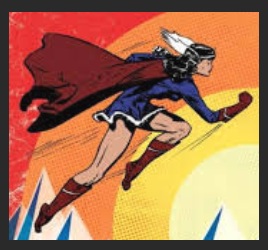
A popular mainstream comic book character in Canada, fighting Axis powers during World War II, Nelvana possessed the power of flight, invisibility, and the ability to travel through light-rays.
However, she did not appear in American comics.
Even if she does not fit our Superhero Criteria, Nelvana certainly deserves our appreciation.
It took a few more decades before a Native American female superhero appeared in mainstream American comics.
Dawnstar first arrived in the DCU in 1977, so she would be considered the first female Native American Superhero to appear in mainstream American comics.
Born on the planet Starhaven, Dawnstar was a winged superhuman whose powers included faster-than-light flight, the ability to survive in the vacuum of space without oxygen, and the capability to track any person or object through interstellar space, across many light-years.
(For another important female Native American superhero, see Echo below.)
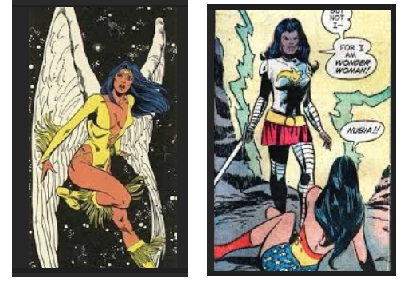
Another iconic trailblazer, and the first Black female superhero, w as Nubia.
She debuted in 1973 as Wonder Woman’s sister (they both were formed out of clay by their mother).
A formidable Amazonian warrior (raised by the War-God Ares/Mars), Nubia often appeared as Wonder Woman’s rival and sometimes as her ally. But Nubia was an extremely powerful female character and one of the first Black superheroes to appear in mainstream comics.
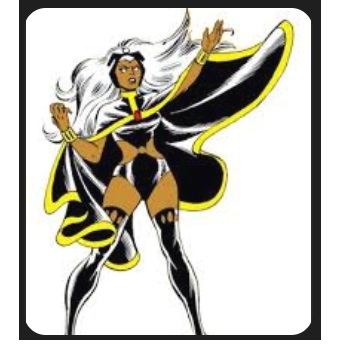
Two years later (in 1975), another major mainstream example of a Black female superhero arrived in comics: the very popular superhero Storm (Ororo Munroe) from the Uncanny X-Men.
It is somewhat trickier to pinpoint the first female Asian character in mainstream American comics, as there were a few contenders from comics in the 1940s that don’t quite fit our criteria—or the ethnicity was never explicitly stated (see Green Turtle in Part 6 ).
However, one female hero who appeared as Asian was Mei Ling, who debuted in Speed Comics (October 1942) from Harvey Comics.
Mei Ling is notable as a rare Chinese heroine from the Golden Age. She also was an active member of the first all-female team of non-powered heroes: the Girl Commandos, who fought against Axis forces during World War II.
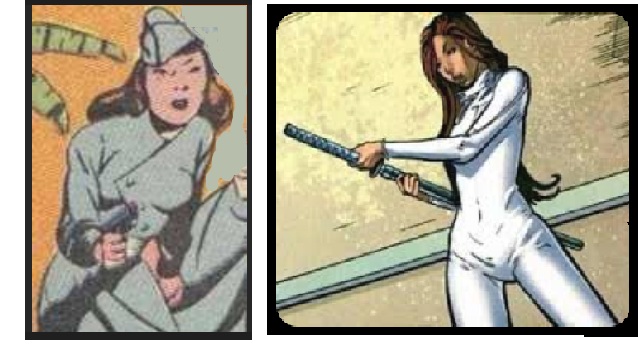
The most widely accepted First Asian superheroine to appear in mainstream comics is Colleen Wing,
The daughter of a Chinese-American professor and a Japanese mother, the remarkable swordmaster Colleen Wing had extensive samurai training. She also was one of Marvel’s early Kung Fu-inspired heroes (along with Shang-Chi and Iron Fist).
While not super-powered, Colleen Wing made her first appearance in Marvel Premiere #19 in November 1974. She fits our criteria due to her peak-human abilities and fighting skills.
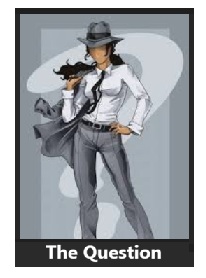
The First Latina Superhero didn’t appear in comics until much, much later.
Debuting in Batman #475 (1992) as a Gotham police officer, Renée Montoya later became a major crime-fighter known as The Question (2006). She also was one of the first prominent (and well-developed) lesbian characters in mainstream comics.
Montoya used a pseudoderm mask and gas to disguise herself as The Question. She also could control her nervous system to manage pain, emotions, and bleeding.
Much later, in 2013, the new Ms. Marvel (Kamala Khan) became the first Pakistani and the first Muslim superhero to have her own comic. She also headlined her own Marvel TV show.
(The first Muslim superhero in American comics was Simon Baz, a Green Lantern, who appeared one year before Kamala Khan.)
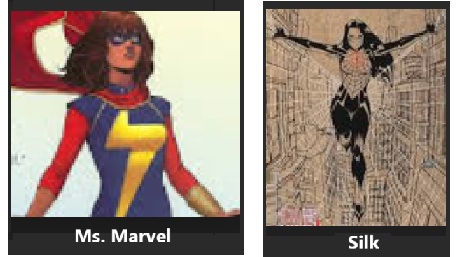
In 2014, Silk (Cindy Moon) appeared in The Amazing Spider-Man #1 (Vol 3). Bitten by the same radioactive spider that gave Peter Parker his remarkable superpowers, Silk was similarly powered (in some cases, more so).
She also became the first Korean-American superhero.
Although this article isn’t focused on non-comic book media, Simu Liu became the first Asian to headline in a Marvel movie when he played Shang-Chi in the 2021 blockbuster.
However, he was not the First Asian Superhero to appear in the Marvel Cinematic Universe.
Chloe Bennet (who played Skye/Daisy/Quake in the AGENTS OF S.H.I.E.L.D. TV show that premiered in 2013) deserves full honors as the First Asian Superhero to appear in the MCU.
Mention must also be given to another Marvel character: Echo—the Cheyenne/Choctaw hero Maya Lopez.
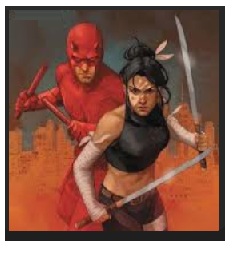
Echo holds the distinction of being the First Hearing Impaired Superhero.
She made her first comic book appearance in Daredevil (Vol. 2) #9 (December 1999).
She also headlined her own TV series. Kudos for that, Marvel.
Deaf-from-birth, she possessed photographic reflexes and could mimic any action she sees.
(For more about Superheroes with Disabilities., see Part 8.)
For more milestones in comic books, check out Part 6, where we delve into some of the first appearances of Black superheroes.

A lifelong collector of comic books, S. T. Finn is an author and artist who lives in a cabin in the Catskill Mountains. His stories and artwork can be found at ShadowfaxBooks.com.
 Shadowfax Books