An Exploration of Superhero Diversity and Representation
by S. T. Finn
If you’ve always wanted to learn more about the representation of Black superheroes in comics, you’re in the right place.
This 10-Part article provides a glimpse into pioneering trailblazers, important first appearances, and the evolution of under-representation in comics.
Part 1 lays the groundwork and sets up our Superhero Criteria.
Part 2 examines the beginning of superheroes (and their predecessors).
Part 3 delves into changing readership imbalances and the romance genre.
Part 4 honors first appearances of important female superheroes.
Part 5 appreciates trailblazing female BIPOC superheroes
Part 6 presents important first appearances of Black superheroes.
Part 7 explores Asian, Hispanic/Latino, and Native American superheroes.
Part 8 celebrates first appearances of superheroes with disabilities.
Part 9 looks at the first gay, lesbian, trans, and nonbinary superheroes.
Part 10 brings it all to a dramatic conclusion.
NOTE: As we discussed in Part 1, for the purposes of this article, a superhero is defined as a crime-fighter who fights for justice, and MAY have a mask, cape, or costume, and/or a secret identity, but MUST possess at least one of the following: 1) a special, peak-human, or unnatural skill or talent; 2) unique tech/gadgets used for crime-fighting; 3) a supernatural ability of some kind; OR 4) an actual super-power.
ALSO, if a hero does not possess a superpower, our Superhero Criteria stipulates that supernatural abilities MUST exist somewhere in the fictional universe for the hero to be considered a superhero (otherwise, they are “simply” a hero, vigilante, or crime-fighter).
With some exceptions, this article focuses mainly on mainstream American comics.
Part 6: BIPOC Supers
As we mentioned earlier, comic books have always been a reflection of the way social perspectives exist and evolve in our society. Comics have often been progressive vehicles for social change.
Although Black, Asian, Hispanic/Latino, Native American, female, LGBTQ+, and other minority superheroes often did exist in comics (including superheroes with disabilities), far too often they were relegated to the sidelines, were presented as sidekicks, or their characters were racially stereotyped.
And yet, there were some very important appearances too, each one remarkable in their own way.
Below is a glimpse at a those who boldly forged the way for others to follow.
Black Power Rises
The first Black crime-fighter to appear in comics was Lothar, who debuted in the newspaper comic strip, Mandrake the Magician, on June 14, 1934.
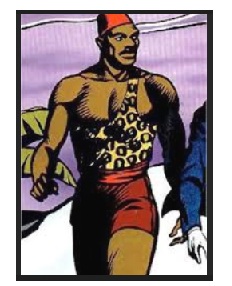
A central character in the Mandrake comics, Lothar was the Magician’s best friend, confidant, and valued crime-fighting partner. He also was known as “the strongest man in the world” (able to lift an elephant with one hand).
In modern terms, Lothar can be seen as a somewhat complex (or even controversial) figure in comic book history. He represents an unusual mix of groundbreaking, respectful, racial representation in the mid-1930s … right alongside deeply ingrained and problematic racial tropes.
Originally portrayed as an African prince who chose to leave his kingdom to travel the world with Mandrake, early depictions of Lothar reflected stereotypical and racial stereotypes of colonialism, often presenting Lothar with exaggerated features, wearing a fez and leopard skins, and speaking in broken English.
Lothar was sometimes presented as Mandrake’s “manservant” and at other times as Mandrake’s most loyal best friend and crime-fighting equal. It seems sad to mention something like this as a compelling point in our current era, but Lothar was often treated with more respect by fellow cast members than many other contemporaneous depictions of Black characters in comics.
However, reflecting the evolving social attitudes regarding race in America (from the 1930s to the Civil Rights era), Lothar was finally modernized in the 1960s and transformed into an intellectual equal to Mandrake without broken English.
In many ways, Lothar remains a somewhat underrated and underappreciated character who represents an early (or the first) example of an interracial crime-fighting team.
Despite the initial racialized, stereotypical elements, Lothar is often cited as one of the first serious Black heroes in comics, and one of the first heroic Black crime-fighters in comic book history—if not the first.
Because Lothar was nearly invulnerable to conventional weapons, impervious to extreme heat and cold, and he possessed extraordinary stamina and strength, Lothar would have to a top candidate for the position of First Black Superhero (even if he was essentially a sidekick).
However, while starting out in newspaper comic strips in 1934, Lothar didn’t make his first appearance in a comic book until June 1938, shortly after the debut of Superman (April 1938).
The First Non-Sidekick Black Superhero
The first Black superhero to appear in comics (not as a sidekick) exists in a single comic book, published in June 1947, with a small print run and limited distribution. Although he never appeared in mainstream comics, this comic book hero deserves special mention.
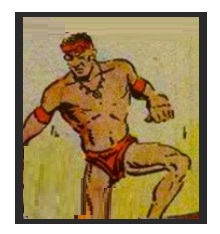
Lion Man was an African-born scientist with superhuman strength and intelligence who protected a “magic mountain” of uranium on the African Gold Coast.
Lion Man debuted as a superhero in All-Negro Comics #1, which was a pioneering achievement in its time: the comic book was owned, written, and drawn entirely by Black artists.
(Incidentally, widely regarded as the first Black detective featured in a comic book, Ace Harlem also appeared in All-Negro Comics #1. For another groundbreaking comic book company owned and operated by Black artists, see Milestone Comics below.)
Although Lion-Man was a remarkable trailblazer, it wasn’t until decades later that the first Black superhero appeared in mainstream American comics.
By then, we had entered the Silver Age (1956–1970), ushering in a resurgence of superheroes, sci-fi themes, and the rise of Marvel Comics (with Spider-Man, Fantastic Four, X-Men, Avengers, etc.).
Enter the Black Panther
The world of comics would never be the same after Marvel presented the First Black Superhero in mainstream comics: T’Challa of Wakanda.
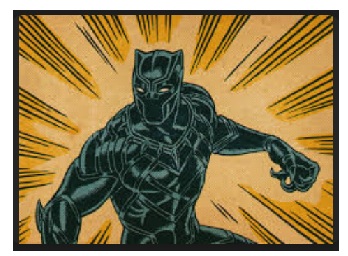
Created by Stan Lee and Jack Kirby, Black Panther debuted in Fantastic Four #52 (July 1966).
T’Challa was a pivotal, pioneering figure because he wasn’t a sidekick. He was a super-powered king of an African nation.
(Note: Black Panther debuted in comics just a few months before the unrelated Black Panther Party formed in California.)
Black Panther’s superpowers arise from the mystical Heart-Shaped Herb (a vibranium-mutated plant) and advanced Wakandan technology, granting him superhuman strength, speed, stamina, agility, and enhanced senses. He also possessed superhuman healing and immunity to toxins.
On top of all that, Black Panther possessed genius-level intellect, expert fighting-skills, advanced vibranium-infused suits, and weapons that absorbed kinetic energy.
All of which makes him an amazing superhero in every sense of the word.
Other Important Supers
The Falcon (Sam Wilson) appeared in Captain America #117 (September 1969), making him the First Black American Superhero in mainstream comics.
While not super-powered, the Falcon utilized a special suit with mechanical wings to fight villains (much like Iron-Man with his armored suit). The Falcon was Captain America’s crime-fighting partner and closest friend for decades.
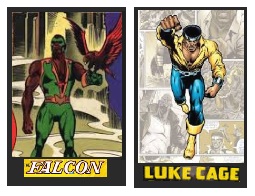
It wasn’t until 1972 that a Black comic-book superhero headlined his own comic-book title: Luke Cage, Hero For Hire.
Also known as Power Man, Luke possessed superhuman strength, unbreakable skin, and enhanced stamina. A pioneering comic book hero, he was also able to recover quickly from injuries. (He also headlined his own Marvel TV show.)
(Incidentally, when Nicholas (Coppola) Cage went into acting, he took Luke’s last name as a homage to the hero he loved so much in the Hero For Hire comics he read as a kid.)
In Part 5, we already discussed the trailblazing first Black female superhero Nubia, who debuted in 1973—as well as Storm (Ororo Munroe) of the Uncanny X-Men (May 1975).
Almost a month before Storm appeared, Bronze Tiger (Benjamin Turner) debuted in comics (April-May 1975).
One of the earliest, prominent Black martial arts superheroes in mainstream DC Comics, the Bronze Tiger was a top-tier martial-artist (who even defeated Batman).
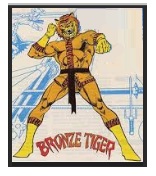
The Bronze Tiger also was a foundational member (and the ethical anchor) of the Suicide Squad.
With no relation to the Bronze Tiger, by this point, we entered the Bronze Age (1970–1985), marked by a shift toward darker, more socially conscious, and realistic storylines—as well as improved diversity.
The Bronze Age is often defined by the end of the strict Comics Code restrictions (beginning in the 1970s and culminating in 2011), as well as the rise of “anti-heroes” like Wolverine (a Canadian, by the way).
An Important Milestone
Similar to All-Negro Comics mentioned above, Milestone Comics also deserves special mention for their diverse, pioneering comics.
Launched in 1993 (with distribution from DC Comics), Milestone Comics was created as an independent, Black-owned and Black-operated company that aimed to correct the lack of representation in the comic book industry by featuring Black and minority characters in their storylines.
While Milestone comics were pioneering and critically acclaimed, some industry peers and retailers believed their comics were meant “for Black audiences” only, which limited their reach and their recognition.
Because of this, their pioneering venture lasted only four years.
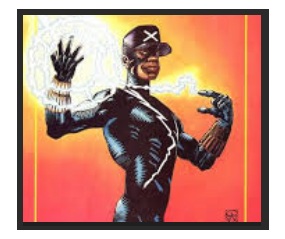
However, at least one of Milestone’s groundbreaking characters lives on: Static (Virgil Hawkins).
One of the first African-American teenage superheroes to headline his own popular comic book, Static transitioned from a Milestone / DC comic book character to the star of the Emmy Award-winning Static Shock animated series (2000–2004).
That really is a Milestone.
For more exciting appearances in comic book history, check out Part 6, where we explore the debuts of Asian, Hispanic/Latino, and Native American superheroes.

A lifelong collector of comic books, S. T. Finn is an author and artist who lives in a cabin in the Catskill Mountains. His stories and artwork can be found at ShadowfaxBooks.com.
 Shadowfax Books