An Exploration of Superhero Diversity and Representation
by S. T. Finn
If you’ve always wanted to learn more about superhero representations of Asian, Hispanic/Latino, and Native Americans in comics, come right this way…
This 10-Part article provides a glimpse into pioneering trailblazers, important first appearances, and the evolution of under-representation in comics.
Part 1 lays the groundwork and sets up our Superhero Criteria.
Part 2 examines the beginning of superheroes (and their predecessors).
Part 3 delves into changing readership imbalances and the romance genre.
Part 4 honors first appearances of important female superheroes.
Part 5 appreciates trailblazing female BIPOC superheroes
Part 6 presents important first appearances of Black superheroes.
Part 7 explores Asian, Hispanic/Latino, and Native American superheroes.
Part 8 celebrates first appearances of superheroes with disabilities.
Part 9 looks at the first gay, lesbian, trans, and nonbinary superheroes.
Part 10 brings it all to a dramatic conclusion.
NOTE: As we discussed in Part 1, for the purposes of this article, a superhero is defined as a crime-fighter who fights for justice, and MAY have a mask, cape, or costume, and/or a secret identity, but MUST possess at least one of the following: 1) a special, peak-human, or unnatural skill or talent; 2) unique tech/gadgets used for crime-fighting; 3) a supernatural ability of some kind; OR 4) an actual super-power.
ALSO, if a hero does not possess a superpower, our Superhero Criteria stipulates that supernatural abilities MUST exist somewhere in the fictional universe for the hero to be considered a superhero (otherwise, they are “simply” a hero, vigilante, or crime-fighter).
With some exceptions, this article focuses mainly on mainstream American comics.
Part 7: Super-Individuals
Similar to Black, female, and LGBTQ+ superheroes, Asian, Hispanic/Latino, and Indigenous superheroes (or those from other cultures and with disabilities), have frequently been left out of American comic books—aside from stereotypical or outright racist representations.
They’ve also been presented as villains throughout much of comic book history (we’re looking to you, Dr. Fu Manchu).
Although many under-represented superheroes did exist, far too often they were relegated to the sidelines, created as sidekicks, or horribly stereotyped.
In this segment, we’ll meet more trailblazers in the comic book world.
The Power of Asian Superheroes
As mentioned in Part 2, Ōgon Bat (Golden Bat) was a caped Japanese character who first appeared in kamishibai (paper theater) in 1930. He was presented with a skull-like face, the ability to fly, and super-strength.
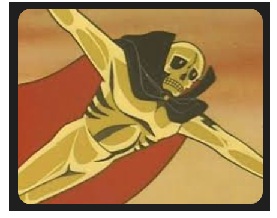
If Golden Bat had appeared in mainstream American comics, he would have been our pick for First Asian Superhero. Nevertheless, this Japanese hero certainly deserves credit for potentially being the first Asian superhero in the world.
Kato
A top candidate for First Asian Superhero in America would have to be Kato—a mysterious masked crime-fighter who first appeared on the Green Hornet radio series in 1936 (about two years before Superman’s debut).
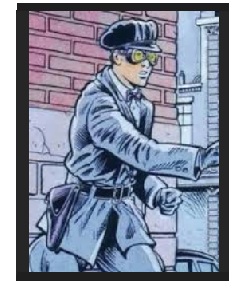
Initially, Kato was portrayed as Japanese (which was changed after the start of World War II—first to Korean and then to Filipino).
He was considered a brilliant scientist, a skilled driver and mechanic, and a jujitsu expert. Kato was also famously portrayed by Bruce Lee in the short-lived Green Hornet television series (1966–1967).
Kato’s first appearance in comics wasn’t until December 1940 (almost a year before Wonder Woman).
Generally speaking, Kato is considered more of a sidekick, rather than a superhero. But to be fair, so was Robin—and Dick Grayson has always been considered a superhero, fighting right alongside Batman.
However, although Kato wore a mask, had a secret identity, possessed peak-human fighting abilities, and utilized unique crime-fighting gadgets (many of which he personally created), no superhuman abilities exist anywhere in The Green Hornet universe.
So, unfortunately, as awesome as Kato was, he does not fit our Superhero Criteria.
The First Asian Superheroes
Another character who is often considered the first Asian superhero in a mainstream American superhero comic … Wing How battled crime alongside the Crimson Avenger (see Part 2).
First appearing in Detective Comics #20 (October 1938), Wing was a Chinese immigrant who moved to America to escape Japanese persecution right before World War II.
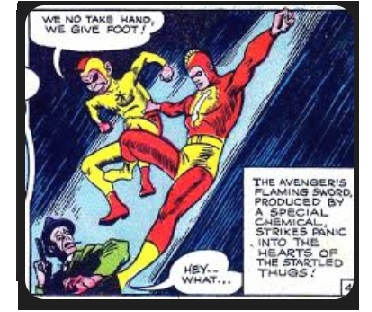
Wing first donned his yellow costume in Detective Comics #59 (Jan 1942)—though some sources say World’s Fines t#4 (1941).
While often portrayed as a racially stereotyped sidekick who spoke in broken English and had exaggerated facial features, Wing also helped instill a social conscience in the Crimson Avenger.
Although Wing possessed no superpowers, he was a skilled fighter and powers did exist in his world (DC Comics). But he doesn’t quite fit our criteria.
Wing didn’t use tech/gadgets. He wasn’t a peak-human. He possessed no unnatural skill or talent (although he certainly was a brave and proficient fighter). And he had no supernatural ability or superpower.
However, Wing is historically significant for being the First Superhero Sidekick Ever, predating Robin by nearly two years.
Another important candidate for one of the First (non-sidekick) Asian Superheroes is the Green Turtle.
Debuting in Blazing Comics #1 (in June 1944) and disappearing after only five issues, Green Turtle is a great example of how comics often had to use subversive tactics to be progressive.
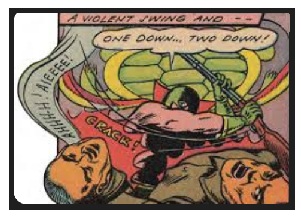
In the case of Green Turtle, the Asian identity of the hero had to be hidden from readers when he first appeared. The publisher wouldn’t allow the Green Turtle to be openly Asian in 1944.
(A lot of people still don’t realize that Chinese Americans weren’t even allowed to vote in the US until 1943.)
To keep his Chinese identity hidden from readers, Green Turtle’s real name was never revealed and his face always partially hidden in shadows or turned away.
However, the Green Turtle was the First Asian American Superhero to be created by an Asian.
Born into a Chinese family on the Hawaiian island of Kauai, Chu F. Hing created the Green Turtle during World War II to promote US-Chinese solidarity.
Green Turtle is also the first Asian superhero to headline in his own comic book, decades before the next Asian headliner.
Nevertheless, the Green Turtle never appeared in mainstream comics, so he too does not fit our criteria.
The FIRST Asian Superhero in Mainstream Comics
It wasn’t until decades later (in January 1970) that the First Asian Comic Book Superhero was openly presented in a mainstream comic as Asian.
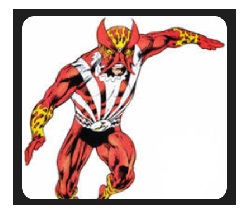
Sunfire (Shiro Yoshida) was a super-powered mutant from Japan who debuted in X-Men #64.
He possessed the power to absorb solar radiation and convert it into super-heated plasma (which he could use as intense fire-blasts).
Sunfire was able to generate temperatures up to a million degrees Fahrenheit. He could also fly by creating super-heated air currents, and protect himself with a psionic aura.
According to the criteria we outlined at the beginning, Sunfire is the First Asian Non-Sidekick Superhero in mainstream American comics.
Another key Asian superhero (who recently headlined his own Marvel movie starring Simu Liu): Shang-Chi, Master of Kung Fu.
Shang-Chi was at the forefront of the “kung fu craze” of the 1970s. Initially, he was a trope-heavy character, created to capitalize on the popularity of Bruce Lee and martial arts cinema, but he was one of the first prominent Asian protagonists to be featured in American superhero comics (and the first headliner).
Introduced in Special Marvel Edition #15 (1973), Shang-Chi became a sensation, proving that an Asian-led title could survive in the Marvel Universe. His groundbreaking Master of Kung Fu comic book series ran for over 100 issues until 1983).
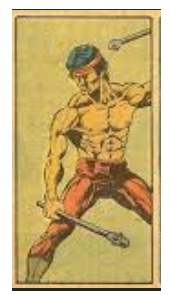
Originally presented as biracial in the comics, Shang-Chi was the son of Fu Manchu (a character deeply rooted in “Yellow Peril” stereotypes) and an unnamed white woman, who had been specifically chosen by Manchu for her genetic potential to give birth to the ultimate assassin.
(After the 2021 movie changed his parentage to fully Chinese, Shang-Chi’s comic book character was retconned as well.)
After he rebelled against his father, Shang-Chi became an important Marvel hero—an Asian who was presented as a heroic lead protagonist rather than as a villain, sorcerer, or sidekick.
As mentioned in Part 5, the most widely accepted first Asian Super-Heroine was the sword-master Colleen Wing (who first appeared in November 1974). In 2014, Silk (Cindy Moon) became the first Korean-American superhero.
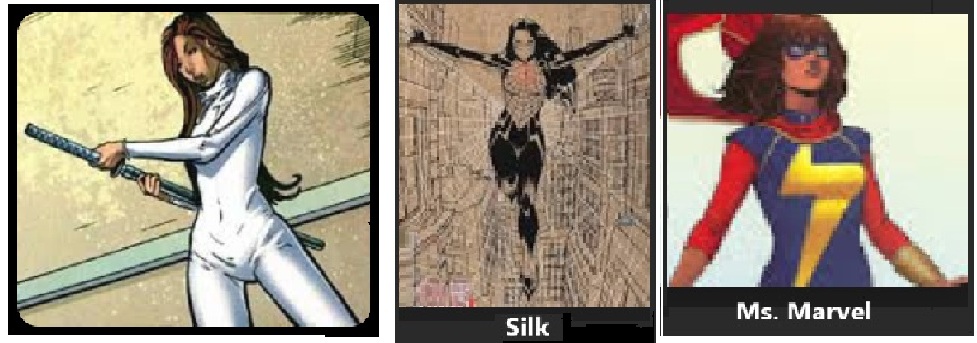
A year earlier, the new Ms. Marvel (Kamala Khan) became the first Pakistani and the first Muslim female superhero to have her own comic.
(The first Muslim superhero to appear in American comics was Simon Baz, a Green Lantern.)
Super Hispanic / Latino Heroes
No discussion of Hispanic / Latino heroes in American comics can begin without first mentioning one of my personal all-time favorite heroes: Zorro.
A foppish Los Angeles nobleman who dons a mask and cloak to fight injustice with his rapier, Don Diego Vega made his first appearance in the pulp magazine All-Story Weekly on August 9, 1919.
A bit over a year later, Zorro made his exciting debut in movies: The Mark of Zorro silent film, starring Douglas Fairbanks (November 1920).
Zorro’s first official appearance in comic books wasn’t until Dell’s Four Color #228 (1949). Nevertheless, ever since his first appearance in the movies, Zorro has widely recognized as the primary archetype for all masked vigilantes.
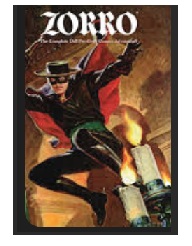
Wearing a mask, having a secret identity, fighting for justice, and possessing impressive sword-skills almost qualifies him as a superhero under our criteria. But not quite.
No super-powered individuals exist in the fictional world of Zorro. So, as awesome as he is as a hero, Zorro does not qualify as a superhero.
There was another Southwestern hero, clearly modeled after Zorro, who debuted in Flash Comics #1 (1940).
The Whip (Rodrigo / Rodney Gaynor) was a crime-fighting hero who wielded a whip (instead of a sword) as he fought for the poor and powerless throughout the American Southwest.
The First Half-Mexican Hero in comics, The Whip had a secret identity, a mask, and a specialized, peak-human skill with his whip.
But, like Zorro, there were no superpowers in his fictional world, so the Whip also doesn’t qualify as a superhero.
But he does win points for early inclusion in comics.
The First Hispanic / Latino Superhero
Decades after those Golden Age heroes, we reach our next important hero on this particular list.
Appearing in Deadly Hands of Kung-Fu #19 (December 1975), White Tiger (Hector Ayala) is generally considered the First Hispanic / Latino Superhero in mainstream American comic books.
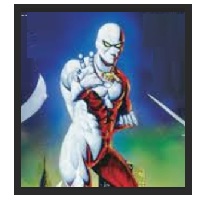
Initially a Puerto Rican college student in New York City, Ayala gained superhuman strength and martial-arts skills from a pair of mystical tiger amulets. (He recently appeared in the Daredevil Reborn TV series—briefly.)
Native American Power
Although there had been a number of early, non-costumed Indigenous characters in American comics (and Nelvana in Canada), some people believe the first Native American superhero in comic books was Tonto.
First appearing on a radio show in February 1933, Tonto debuted in comic books along with the Lone Ranger in 1948 (and gained his own series in 1951).
As much as I love Tonto, he does not fit our Superhero Criteria because super-powered people did not exist in Tonto’s Wild West universe. Not even the Lone Ranger counts as a superhero in that regard.
Besides, another Native American superhero did appear before Tonto.
In Part 5, we already discussed the first Native American female superhero: Nelvana of the Northern Lights—one of the first Canadian superheroes, one of the first non-white superheroes ever, and technically the first Native American comic book superhero.
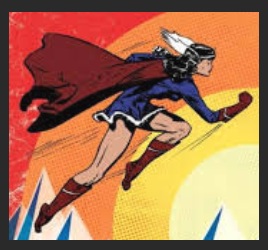
She first appeared in August 1941.
However, since Nelvana did not appear in American or mainstream comics, the top contender for First Indigenous Superhero would have to be … Super-Chief.
Also known as Flying Stag, Super-Chief first appeared in DC’s All-Star Western #117 (1961).
Flying Stag was a 15th-century Iroquois warrior with supernatural powers. Using a mystical amulet formed from a meteorite, Super-Chief gained super-strength and speed that he used to protect his people. So, he definitely qualifies in our Superhero Criteria.
It took another decade or more before Marvel’s pioneering character Red Wolf (William Talltrees) appeared in The Avengers #80 (September 1970).
Red Wolf was not merely a skilled warrior. He also was empowered by the Cheyenne wolf-god Owayodata, which gave him super-strength, enhanced senses, and an immunity to telepathy.
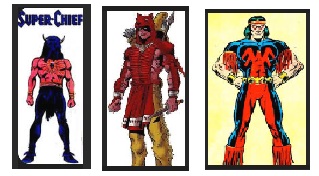
Five years later (1975), Thunderbird (John Proudstar) appeared in Giant-Size X-Men #1. Although the character did not last long, his younger brother Warpath (James “Jimmy” Proudstar) first appeared in New Mutants #16 about a decade later (June 1984).
They both possessed superhuman strength, speed, stamina, heightened senses, and the ability to withstand immense physical impact.
And that brings us into the Modern Age (1985–Present), which began with the publication of Watchmen and The Dark Knight Returns.
With a relaxing of the Comics Code (and its eventual demise), the Modern Age was characterized by complex and gritty storylines. What will the Next Age in Comics be?
In many ways, it’s up to us.
As the great Stan Lee used to say … Nuff said.
To learn about superheroes with disabilities in comics, check out Part 8

A lifelong collector of comic books, S. T. Finn is an author and artist who lives in a cabin in the Catskill Mountains. His stories and artwork can be found at ShadowfaxBooks.com.
 Shadowfax Books