
An Exploration of Superhero Diversity and Representation
by S. T. Finn
If you’ve always wanted to learn more about superheroes with disabilities in comics, you’re in the right place.
This 10-Part article provides a glimpse into pioneering trailblazers, important first appearances, and the evolution of under-representation in comics.
Part 1 lays the groundwork and sets up our Superhero Criteria.
Part 2 examines the beginning of superheroes (and their predecessors).
Part 3 delves into changing readership imbalances and the romance genre.
Part 4 honors first appearances of important female superheroes.
Part 5 appreciates trailblazing female BIPOC superheroes
Part 6 presents important first appearances of Black superheroes.
Part 7 explores Asian, Hispanic/Latino, and Native American superheroes.
Part 8 celebrates first appearances of superheroes with disabilities.
Part 9 looks at the first gay, lesbian, trans, and nonbinary superheroes.
Part 10 brings it all to a dramatic conclusion.
NOTE: As we discussed in Part 1, for the purposes of this article, a superhero is defined as a crime-fighter who fights for justice, and MAY have a mask, cape, or costume, and/or a secret identity, but MUST possess at least one of the following: 1) a special, peak-human, or unnatural skill or talent; 2) unique tech/gadgets used for crime-fighting; 3) a supernatural ability of some kind; OR 4) an actual super-power.
ALSO, if a hero does not possess a superpower, our Superhero Criteria stipulates that supernatural abilities MUST exist somewhere in the fictional universe for the hero to be considered a superhero (otherwise, they are “simply” a hero, vigilante, or crime-fighter).
With some exceptions, this article focuses mainly on mainstream American comics.
Part 8: Super Challenges to Overcome
Throughout comic book history, people with disabilities have appeared, although rarely as superheroes. But those rare appearances have existed and have been remarkable nonetheless.
Many Golden Age characters with disabilities were noteworthy for being represented as heroes who adapted to their conditions rather than being sidelined by them. Often, these early characters used their disabilities as a source of (or inspiration for) their superpowers
In Part 5, we mentioned how the Native American superhero Echo was the First Hearing Impaired Superhero in comics history when she debuted in Daredevil (Vol. 2) #9 (1999).
Many people also believe that Daredevil (Matt Murdock) was the first blind superhero. But the mantle of First Visually Impaired Superhero actually belongs to DC’s Doctor Mid-Nite.
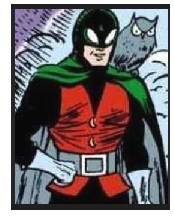
After losing his eyesight to a mob-related grenade, Dr. Charles McNider discovers that, even though he is fully blind in daylight, he can see in total darkness. To fight crime, he develops “blackout bombs” that blind his opponents, while he wears special “infrared” glasses to navigate and battle disoriented villains.
Appearing in All-American Comics #25 (April 1941), Doctor Mid-Nite became the First Superhero With a Disability in comic book history.
Debuting earlier than Dr. Mid-Nite (in 1940), the Golden Age Daredevil (Bart Hill) had no relation to the later Marvel character (Matt Murdock).
Due to the trauma of witnessing his parents’ murder (and then experiencing torture), Bart Hill was rendered mute for years. However, he adapted to his disability by extensive training with Australian Aborigines (in the use of a boomerang) and communicated with notes and gestures before his speech returned much later.
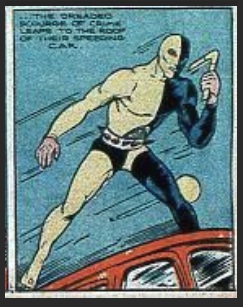
While the Golden Age Daredevil had no superhuman powers. he was considered a peak-human athlete, master acrobat, and expert hand-to-hand combatant who mainly battled super-powered villains with boomerangs he could throw with deadly accuracy.
Nightro (Jeff King) debuted in Daredevil Comics #2 (1940). Although he was a short-lived character, he was blinded in a snowstorm and later wore specialized “polaroid glass” goggles to partially regain his sight for crime-fighting.
In Whiz Comics #25 (December 1941), Captain Marvel Jr. (Freddy Freeman) entered the comic book world of Fawcett’s Captain Marvel. After a brutal attack by the villain Captain Nazi, Freeman’s back was broken and his left leg was paralyzed, forcing him to walk with a crutch.
While Freeman has a major, permanent disability, his injuries disappear whenever he transforms into Captain Marvel Jr.
Appearing two decades later, one of the most renowned Marvel superheroes with a disability was the Silver Age Daredevil (Matt Murdock), who debuted in Daredevil #1 (April 1964).
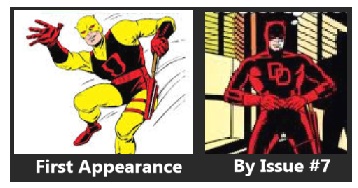
Blinded in childhood during a chemical accident that enhanced his other senses, Daredevil became a top-tier superhero, despite his damaged eyesight.
Daredevil had enhanced, superhuman senses—hearing, smell, touch, and taste—and he developed something like a “radar sense” for 360-degree environmental mapping, allowing him to fight and navigate as an expert martial-artist and acrobat.
His senses also serve as a “lie detector” and grant him peak-human reflexes, agility, and immense pain endurance.
Some claim Daredevil doesn’t possess a “true” superpower (suggesting he “just” has heightened senses and is peak-human). While that is debatable, he still meets our Superhero Criteria due to his exceptional peak-human qualities alone.
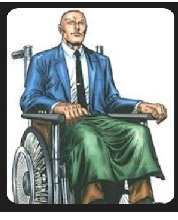
In Marvel’s X-Men #1 (1963) Professor X (Charles Xavier) became the first major, long-term paraplegic superhero in a wheelchair to be featured in mainstream American comic books.
Suffering spinal injuries, Professor X was unable to walk—and yet he was also one of the most powerful mutant telepaths in the world (as well as a scientific genius and leader of the X-Men).
The former Batgirl (Barbara Gordon) is generally considered the first major, long-term paraplegic superhero to appear in DC Comics.
After being shot by the Joker in the 1988 graphic novel Batman: The Killing Joke, Barbara Gordon was paralyzed from the waist down, ending her career as Batgirl.
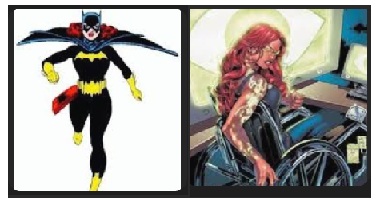
But rather than hang up her cape, Gordon reinvented herself as the IT data-broker Oracle.
First appearing in Suicide Squad #23 (1989), Oracle became one of the most prominent, high-visibility superheroes with a disability in mainstream comics (until Barbara Gordon’s mobility was restored in 2011).
While other characters such as The Chief (Niles Caulder) of Doom Patrol (June 1963) were paraplegic in DC comics earlier, Barbara Gordon’s tenure as Oracle is one of the most significant, high-profile, and enduring portrayals of a paraplegic superhero in DC history.
When it comes to superheroes with learning disabilities, Cassandra Cain (Batgirl II) was depicted as having severe difficulties with speaking and functional illiteracy.
This was due to her severe training as an assassin by her supervillain father, David Cain (who raised her in isolation to be a silent, deadly weapon), along with the League of Assassins and her mother (the lethal supervillain Lady Shiva).
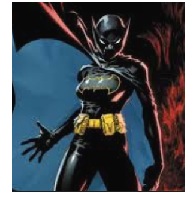
Raised to read body language as a first language rather than speaking, Cassandra Cain experienced some developmental issues with regard to language. However, she was later shown learning to read while operating as a hero.
Cassandra Cain’s first appearance was in Batman #567 (July 1999) and the next year she became the first Batgirl to be featured in an ongoing eponymous comic book series.
In Marvel Comics, the X-Men mutant Jubilee (Jubilation Lee) was presented as having dyscalculia—a learning disability that makes math-related tasks very challenging.
A Japanese-American mutant genius, Wiz-Kid (Takeshi “Taki” Matsuya) used a wheelchair due to paralysis from a childhood accident. He also possessed the power of technokinesis, allowing him to psionically rearrange machinery (including his wheelchair) into vehicles or weapons.
He also had severe dyslexia.
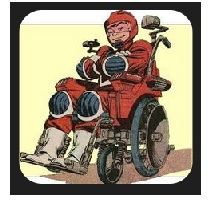
In DC Comics, Impulse/Flash (Bart Allen) has been frequently depicted as dealing with ADHD.
Symbolically, it should be mentioned that some creators have framed all X-Men (and mutants in general) as a metaphor for neurodiversity and hidden disabilities—where “being different” was often misinterpreted as being “lesser.”
As with so many people, the X-Men and other mutants continually show that we all can be underestimated—and, collectively, there’s nothing we can’t achieve.
For more milestones in comic books, check out Part 9, where we explore the first appearances of LGBTQ superheroes.

A lifelong collector of comic books, S. T. Finn is an author and artist who lives in a cabin in the Catskill Mountains. His stories and artwork can be found at ShadowfaxBooks.com.
 Shadowfax Books